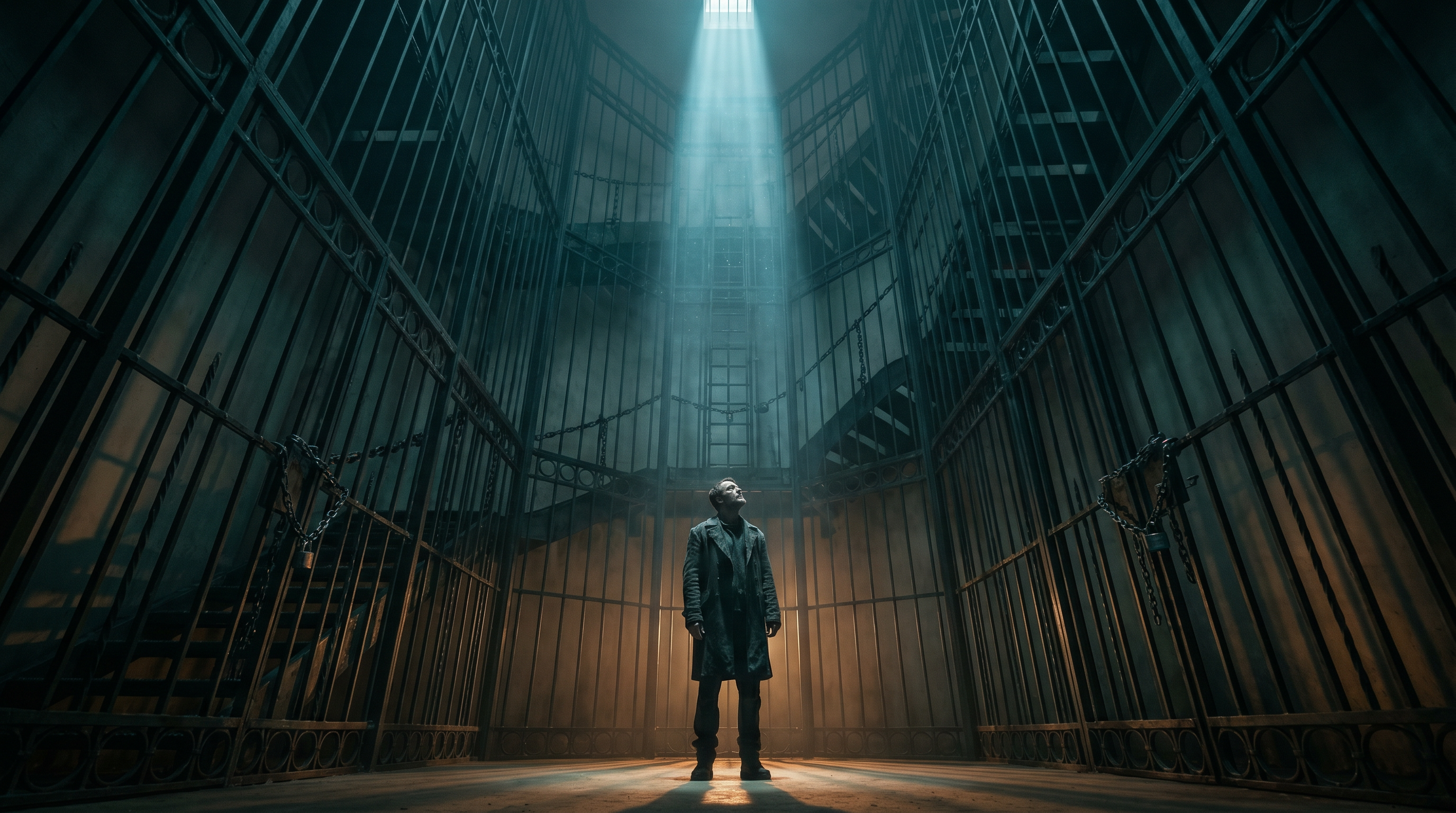
Desire and Expectation Are the Walls of the Prison We Build Around Ourselves
A mantra I formed years ago. I don’t know exactly when… only that by the time it surfaced, I was already pacing the cell.
I did all the terrible things.
I put work first. Consistently, deliberately, without apology… until the apologies started piling up and the relationships I’d let atrophy were too far gone to recover easily. Friendships that deserved attention got rescheduled indefinitely. People who mattered got the version of me that had already spent everything on the job. I told myself it was temporary, that once I reached the next level things would balance out. They didn’t. The next level just had another level above it.
I went from nothing. Intern. Then running a project. Then a studio team. Then IP and product development at Rockstar. I had climbed further than most people in the industry ever do, and I wanted more. I wanted to be a top-line producer… the title, the money, the clout. I wanted the thing I could see through the ceiling.
I’m not writing this to perform regret. I’m writing it because if you are in the middle of that climb right now, I want you to see it clearly… because I couldn’t.
The Prison You Build
The mantra came out of pain, not philosophy.
Desire and expectation are the walls of the prison we build around ourselves.
I formed it in my mid-thirties, somewhere in the grinding friction of doing the real work while watching people above me hold titles I couldn’t see how they’d earned. Maybe they had. Maybe I just couldn’t see it from where I was standing. I was a Senior Producer… global scope, real responsibility. Renegotiating server contracts. Running P&Ls. Managing external partners across time zones. My boss sat in his office playing World of Warcraft on three workstations and made two to three times what I made.
The situation was real. But the prison wasn’t the situation.
The prison was the desire I had been feeding for years… the specific, hungry, non-negotiable wanting of the next rung. The Buddha called it tanha… craving, thirst… and placed it at the root of suffering in the Second Noble Truth: not pain caused by circumstance, but suffering generated from inside, by the mind’s insistence that things must be other than they are. I didn’t know that framework when I was living it. But I was living it precisely.
Layered on top of the desire was expectation… that effort would be rewarded, that competence would be recognized, that the system had a logic that would eventually work in my favor if I just pushed hard enough. None of that was guaranteed. I had decided it was true because I needed it to be.
Together, desire and expectation didn’t just frustrate me. They made the cage feel like a plan.
Maybe you recognize it.
Fuel vs. Prison
I want to be precise here, because the obvious misread is that this is an argument against wanting things.
It isn’t.
I know what the good version feels like. For a stretch at Rockstar I ran a fix-it role… two struggling games dropped on my desk in sequence. The Warriors first. I overhauled the combat system from scratch, including a two-character combo where one player holds an enemy in a headlock while the other punches him in the gut, and a co-op mechanic for lifting a teammate so they can spraypaint a tag on a wall. New control layout to go with it. The kind of work where you can feel the game getting better under your hands.
Then leadership slapped a DVD of Red Dead Revolver on my desk: fix it or cancel it. I watched seventy cowboy movies. I put myself in a pivotal place to help rebuild the look, the feel, the gameplay… until it worked. When it shipped, leadership pulled me and a friend aside: “Now tell me what the western you actually want to make is.”
I wrote one of the first design documents for Red Dead Redemption that week. The name was an intentional pun in the producer pit.
That’s fuel. The desire that rebuilds a headlock-and-gut-punch combo because it has to feel right… that watches seventy westerns not for the credit, but because you need to understand the thing.
Desire as fuel is what gets a game shipped. It’s craft-hunger, curiosity, the particular satisfaction of making something that didn’t exist before. That kind of desire is open… it leans toward something without demanding a specific outcome or staking your identity on a result you can’t fully control.
Prison-desire is different. It has collapsed into a single point… the title, the number, the rung… and it has made that point a condition of your worth. It doesn’t feel like hunger anymore. It feels like necessity. And necessity, by definition, makes you manageable. When someone above you knows you need the next level, they have leverage over every version of you that still believes the next rung will save you.
The same distinction applies to expectation. Reasonable expectations are working hypotheses… provisional, adjustable, open to revision when reality pushes back. Prison-expectations are verdicts. They’ve already decided how the world is supposed to behave, and everything that doesn’t comply becomes a grievance to carry.
The question the mantra asks is not do you want things? It’s what kind of wanting is this, and what is it costing you that you haven’t noticed yet?
The Line That Keeps Moving
Here is something nobody tells you clearly enough about climbing in a creative industry: at a certain altitude, the people above you are often terrible at communicating direction. Not maliciously. Often just structurally… they’re managing politics and optics and their own insecurities, and the actual target gets lost in translation. The line you’re supposed to hit is always slightly vague, slightly further, slightly dependent on factors you don’t control and can’t fully see.
I learned this concretely, not theoretically. I worked at a different well known publisher, and on one of my projects we were preparing to ship a demo and finance wanted to defer the SpeedTree middleware license payment… kick it down the road, deal with it after. I knew the contract. We were legally required to pay before shipping, not after. I told them. They disagreed. I refused to sign off and warned them explicitly: this will result in a lawsuit. They shipped the demo anyway.
We got sued the next week.
I wasn’t vindicated. I was exhausted. The lesson wasn’t that I was right; it was that I had spent real energy, real political capital, real pieces of myself protecting an institution that was going to make the wrong call regardless. The line I was supposed to hit kept moving because the people drawing it weren’t always operating in good faith, or with competence, or with any particular concern for what it cost me to keep reaching.
Epictetus understood this with a clarity that still cuts. Enslaved for part of his life, he knew confinement in the most physical sense… and still wrote that the deepest prison is built from wanting things outside your control. His Enchiridion opens with a blunt distinction: some things are in our control, and others are not. Other people’s decisions, their recognition, their willingness to move you forward… none of that is in your control. Attaching your wellbeing to it is the mistake. The chain isn’t on your wrist. It’s in your wanting.
And then there were the compromises of character. Not dramatic ethical violations… subtler than that.
I’ve made it to the final round of an interview and been turned down because my ambition overshot the role. I’ve been told to sideline skills and experience because they were threatening to the people above me… expected to squeeze into a smaller box, stay in the lane. At one point in my career I changed managers every nine months. Each one had a different interpretation of me, and a different version of the thing I was still missing for my next promotion. The thing kept changing. No real path. No mentorship. Just a line in the sand that someone kept moving.
At a certain altitude the ask stops being about your work and starts being about who you are. I started to wonder whether I recognized myself in the version of me the climb was producing.
Desire fills the gap of unclear direction with effort. You work harder. You sacrifice more. You assume the problem is that you’re not reaching far enough, not that the direction is genuinely unclear or that the people setting it don’t actually know what they want from you. Your hunger makes you complicit in your own exhaustion. The system doesn’t have to hold you down… you hold yourself in place by straining so hard toward something that keeps receding.
But the desire? That was all me. I own that completely. Nobody made me want what I wanted. Nobody made me sacrifice what I sacrificed to chase it.
That’s not self-punishment. It’s the most important thing I can tell you… because if the desire is yours, so is the key.
My last year in New York, I was shuttling between a hotel room in Orange County and my apartment… two weeks there, two weeks back. The relationship I was in didn’t survive it. You can’t really be in a relationship out of a hotel room. The friends I had in New York didn’t disappear — they just slowly stopped expecting me to show up. Wherever I was, I was in triage. I was never really in either place.
And still I reached for the next thing.
Japan
I spent a year in Osaka setting up a global office. Building an MMO from scratch… real IP product development, the kind of work I had been pointing toward for years.
The CEO told me he had raised fifteen million dollars. I told him to give me all of it… that moving from game operations into original IP development was expensive in ways I wasn’t sure he fully understood, that the budget would compress faster than he expected, that underfunding it early was the most reliable way to kill it later. In reality I was trying to secure the 1.8 million I needed to properly start the project. I was trying to protect the thing from the gap between his stated confidence and his actual readiness.
He got cold feet. Didn’t sign the check.
I canceled the project and came home.
The desire had carried me to the other side of the world and the expectation… that the resources would match the rhetoric, that a CEO who said fifteen million meant fifteen million… collapsed on contact with reality. I had done the work. I had been right about what it needed. None of that was enough.
I didn’t have language for it yet, but that was the first time I stopped treating the cage as a plan.
I took a six-month sabbatical.
What Burnout Actually Is
By my mid-thirties I hadn’t fully achieved my desire, and I hadn’t met the expectations… mine or others’. The gap between where I was and where I believed I needed to be hadn’t closed. If anything it had widened, because the further you climb the more clearly you can see the distance remaining.
Growth at that level becomes exponential effort. Each rung requires more than the last… more sacrifice, more compromise, more of yourself fed into the machine. The curve was never going to be sustainable. But desire doesn’t do math. It just points forward and says more.
Alan Watts wrote about the self perpetually in pursuit of itself… the ego chasing its own tail, exhausting itself in the running, never catching what it’s after because catching it would require it to stop being what it is. Taoism frames the same thing as the exhaustion of forcing… acting against the grain of what is natural, spending yourself in resistance to reality rather than moving with it.
The burnout I experienced wasn’t just fatigue. It was the accumulated cost of years of that forcing.
I had built something real. A career that most people in this industry would look at and call a success. I couldn’t see any of it. I was measuring only in one direction… toward the thing I didn’t have yet. That’s what the prison does. It takes your eyes.
The sabbatical wasn’t retreat. It was the first honest accounting I had done in years. Coming back as a Technical Art Director… more individual contributor, hands-on, closer to the actual craft of making things… this looked like a step down from the outside. From the inside it felt like the first free breath I had taken in a long time. The work I had always loved, without the ladder attached to it.
The Mantra as Diagnostic
The mantra didn’t fix anything immediately. What it did was create a moment of distance… a pause between the wanting and the next decision driven by the wanting.
Long enough to ask: is this desire actually mine, or is it a groove I fell into so long ago I stopped questioning it? Is this expectation reasonable, or is it a wall I built to make the cage feel like a plan?
Those are not comfortable questions. They don’t have clean answers. But the asking alone changes something… because you can’t unsee a prison once you’ve recognized the walls.
I’m not going to tell you what I did next. That’s a different piece.
What I’ll tell you is that the mantra held. I’ve carried it across roles, titles, and industries, and it keeps functioning the same way… not as comfort, but as a tool. A way to locate the source of friction before reacting to it. A way to separate the situation from the story I’m telling myself about the situation.
If you’re in the climb right now… if you’re doing the terrible things, if the relationships are fraying, if the line keeps moving, if you’re working harder than the math can sustain… I’m not here to tell you to stop wanting.
I’m here to tell you to look at the walls.
Where It Comes From
I didn’t form the mantra by reading philosophy. I formed it under pressure, in a specific situation, because I needed it.
But somewhere in writing this I started recognizing it in other places. The Buddha called it tanha… craving, the root of suffering. Epictetus wrote that the deepest prison is built from wanting what’s outside your control. Watts talked about the ego chasing its own tail. None of them were wrong.
None of them put desire and expectation together as a paired mechanism… the internal hunger working with the externally imposed demand, both of them building the same walls. That part I had to find myself.
And look — a lot of smart people across a lot of centuries have circled this same territory. That’s not something I dismiss.
I don’t accept things easily. I’ve lived inside this one long enough to know it holds.
For What It’s Worth
The same drive also gave me real things.
I’ve traveled. Had adventures I wouldn’t have otherwise. Hard work has a way of putting you in rooms you couldn’t have planned your way into… at moments, with people, on projects that only happened because you showed up with everything you had. A lot of the prosperity I have now came directly from the same hunger that built the cage.
Work hard, play hard was also true. Both halves of it.
I’m not writing to warn you off ambition. I’m writing about the difference between fuel and prison… and knowing which one you’re running on.
Jonathan Kimball Galloway (HogJonny) is a Principal Technical Artist at Bluepoint Games (Sony SIE) with 30+ years in AAA game development. Views expressed are his own.
If this resonates, The String Theory of Disappointment covers similar territory — what happens when one broken thing gets to rewrite the whole song.
Have thoughts on this? Reach out on Twitter or LinkedIn.
Disclaimer: Views expressed are my own. All opinions are my own. The opinions expressed here belong solely to myself, and do not reflect the views of my current employer Sony Interactive Entertainment (SIE), any previous employers including AWS/Amazon, the Open 3D Foundation, or their parent the Linux Foundation. I am bound by NDAs with my current and previous employers and am not authorized to speak on their behalf. If you are a reporter or news outlet seeking official statements, please contact the respective company's PR department (I will not reply to such requests).
License: For terms please see the LICENSE*.TXT file at the root of this distribution.
// Copyright HogJonny-AMZN. or his affiliates. All Rights Reserved.
// SPDX-License-Identifier: CC-BY-4.0